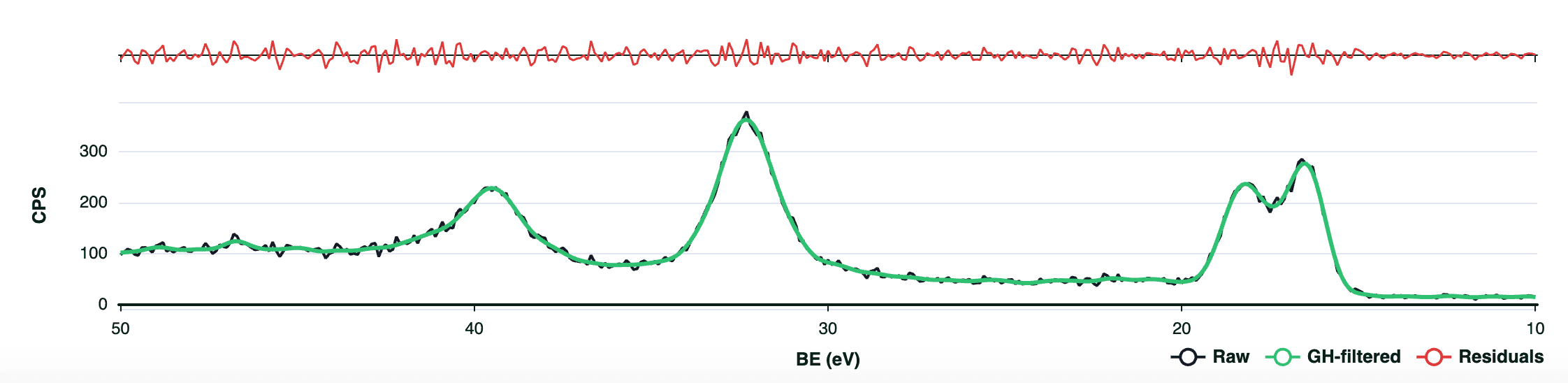
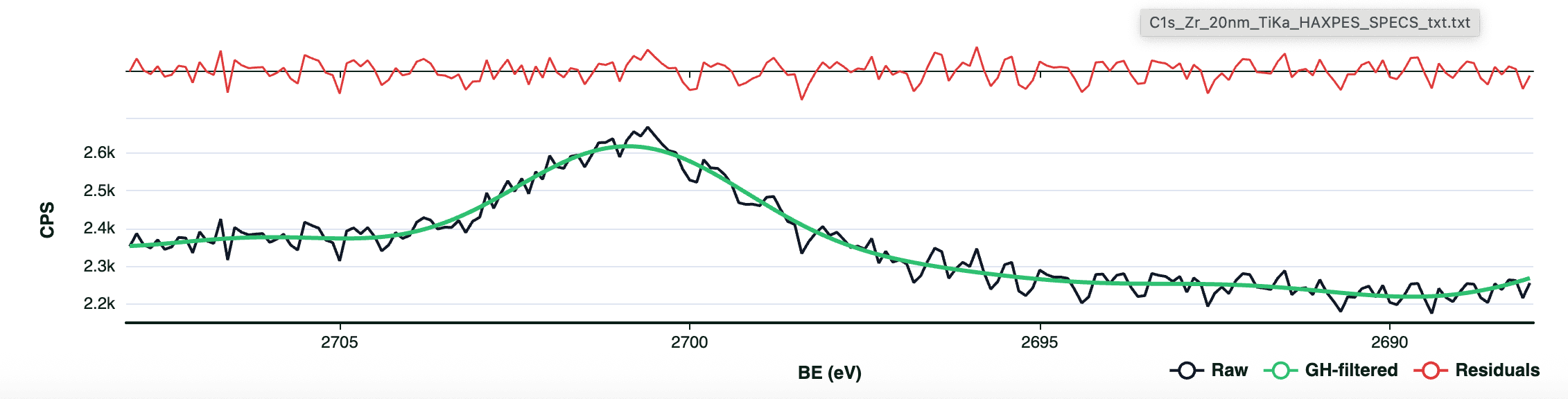
Conventional smoothing leaves noise in your signal
Conventional smoothing methods — including the Savitzky-Golay and boxcar filters — have two problems:
- They leave high-frequency noise in your data
- They don't allow you to see the actual cut-off between signal and noise, which is obvious in reciprocal space and also leaves noise in data
Noisy spectra break AI models
Neural networks trained on noisy data can interpret the noise as signal. High-quality pre-denoised training data is much preferred for reliable AI.
Pre-denoising is table stakes for AIInstrument time is expensive
More scans mean more time — and time on XPS instruments costs your lab real money. Noise from lower S/N spectra can often be reliably removed with the right denoising algorithm.
Every scan saved = cost recoveredBeam damage limits scan counts
Beam-sensitive samples may not be able to generate high-quality (low noise) spectra before they are damaged.
Denoise fewer scans to same qualityDenoised spectra are often closer to the true spectra than the original noisy spectra — making denoising not just useful, but scientifically preferred.
Built on peer-reviewed science. Patent-pending.
Fourier-AI applies a Gauss-Hermite transfer function in reciprocal space — where the physics actually lives — with fully automated software-predicted cutoff placement.
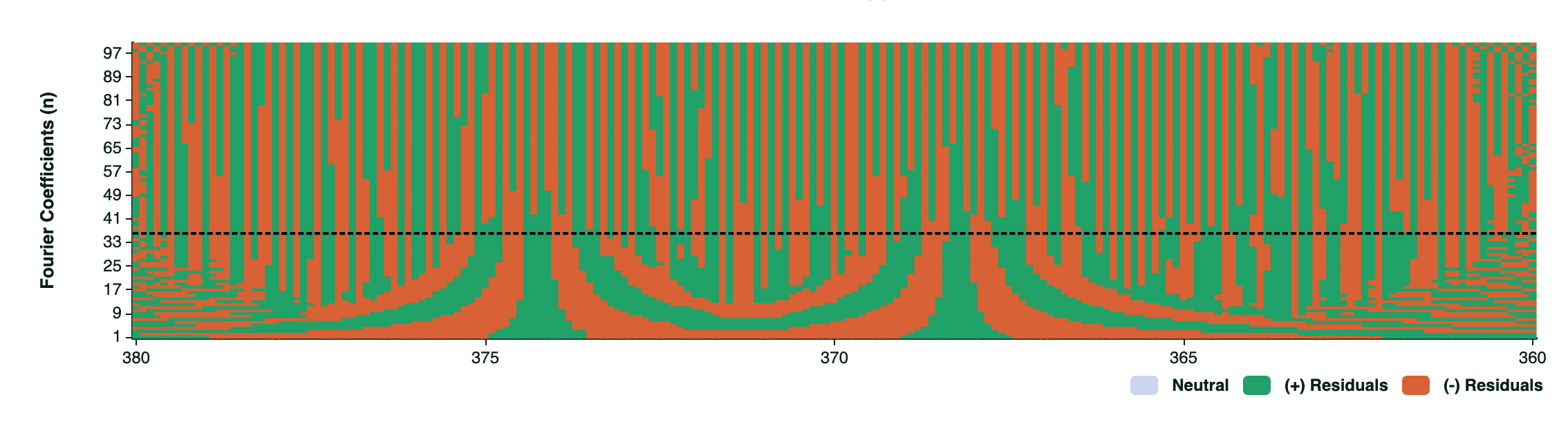
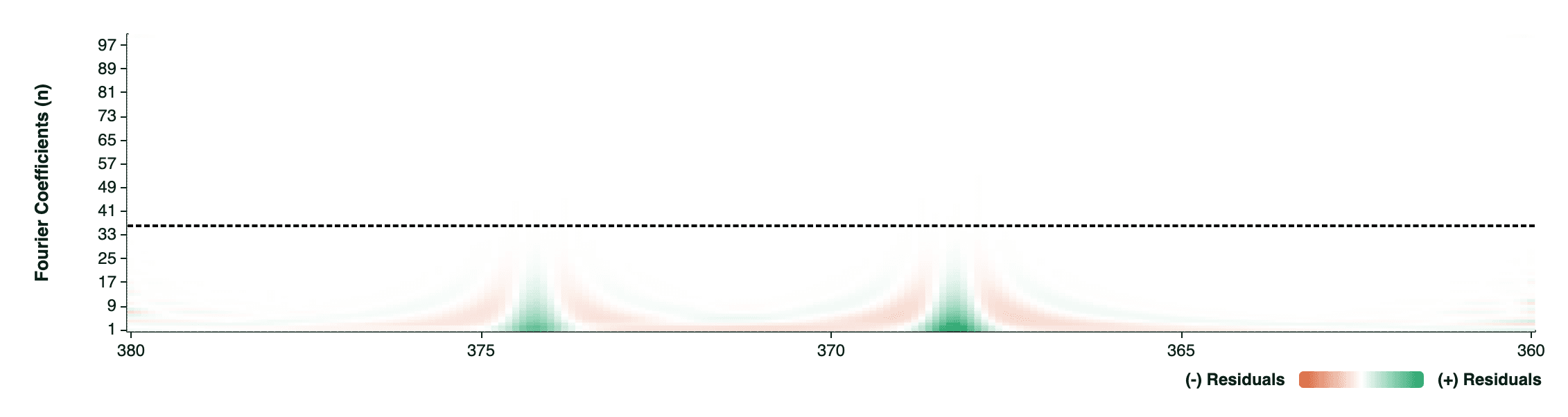
Binary Residual Map™
A novel heatmap-like visualization tool showing the color-coded residuals across a wide range of cutoff values simultaneously. See the full picture in one plot – no competitor offers this.
Automated Software-Predicted Cutoff
Fourier-transformed spectra generally have a region dominated by signal and a region dominated by noise. Our algorithm automatically identifies and places the cutoff between them – no Fourier expertise required. Expert users can override and reset at any time.
Gauss-Hermite Filter
Flat and nearly unity at low frequencies — signal preserved. Approaches zero at high frequencies — noise removed. Smooth monotonic transition that avoids signal distortion. Solves both problems conventional filters fail: noise leakage and information damage.
From raw spectra to publication-ready in four steps
No Fourier expertise required. The software handles the math — you get the results.
Import your data
Upload CSV, TSV, VAMAS (.vms/.vamas), or multi-spectrum files via drag-and-drop.
Fourier transform
The software computes a full sweep of Fourier cutoffs across the entire coefficient space — all at once.
Automated cutoff placed
The cutoff between signal-dominated and noise-dominated Fourier coefficients is placed automatically. The Binary Residual Map™ and the two-line algorithm that identifies the cutoff give you full diagnostic transparency into that decision.
Export denoised spectra
Download publication-ready denoised data as CSV. Adjust cutoff via slider if desired — reset to software-predicted at any time.
Why conventional smooths fall short
The conventional filters in common use work in direct space. They leave high-frequency noise in data and are also hard to optimize in real space, which means more noise gets left in data. In the conventional approach, one is blind to what is going on in reciprocal space, which can also lead to data distortion.
Fourier-AI was founded by researchers with decades of combined publishing, institutional credibility, and domain experience.
Matthew R. Linford
BYU professor and XPS authority. Co-inventor of the automated cutoff algorithm.
Michael P. Jones
BYU CS professor and former VP at multiple software companies. Leads the software architecture and AI integration for the platform.
David E. Aspnes
Applied physicist and noise removal specialist. Emeritus NC State professor and member of the National Academy of Sciences.
Start with the right tier for your lab
We're working directly with early adopters to shape the product. Preferred customers receive prioritized support, feature input, and early access to new modules.
Academic
- ✓Up to 1,050 data points per spectrum
- ✓Up to 50 uploads per day
- ✓CSV / TSV / VAMAS import
- ✓Up to 10 spectra per VAMAS file
- ✓Binary Residual Map™
- ✓Least-squares cutoff algorithm
- ✓Gauss-Hermite filter
- ✓Export denoised spectra
Commercial
- ✓Everything in Academic
- ✓Prioritized feature input
- ✓Direct line to the dev team
- ✓Early access to new modules
- ✓D-parameter tool (coming soon)
Preferred Customer / Collaborator
We're working directly with early adopters to shape the product. Preferred customers receive prioritized support and feature input.
- ✓Everything in Academic & Commercial Premium
- ✓Up to 5,000 data points per spectrum
- ✓Up to 20 spectra per VAMAS file
- ✓Unlimited uploads — no daily cap
- ✓Three-point cutoff algorithm
- ✓Brick-wall filter
- ✓Compare cutoff algorithms side by side, no re-run